© 2035 by The Clinic. Powered and secured by Wix
TatyDesignStudio
Taty Tatyana Horoshko
“Essence” from Coney Island Avenue: The Birth of a Miracle on a Forgotten Stage

© 2035 by The Clinic. Powered and secured by Wix

Sometimes fate offers us encounters we could never ask for in advance — they can only be stumbled upon by chance, like a beam of light in a dark corridor.
A month ago, I volunteered to help some acquaintances by filming a performance at a theater festival on the stage of the ATA — American Theatre of Actors — in Manhattan. The decision was spontaneous and purely voluntary: I wanted to spend an evening in the theater, meet a new company, put my camera to work . I had no idea what kind of festival it was, and even less — what kind of performance I was about to see. In fact, I didn’t even know the theater itself; I had met its actors for the very first time just a few hours earlier.
The theater studio ESSENCE, from Coney Island Avenue, is made up of people with different professions — women immersed from morning till night in family life and everyday responsibilities — were resisting monologues from "Voice of a woman". Ordinary people, without formal theater education, yet possessing remarkable honesty and inner freedom. Even then, I thought: this director knows how to hear a person, how to persuade them to reveal the best within themselves, and how to help them overcome the fear of showing a character’s temperament and truth on stage — inevitably investing a part of his own “self” into them.
It was his wife, actress Vasilisa Vasilyeva, who invited me to the festival.
“You promised — please film it for us,” she said.
I agreed without hesitation. Who could have known that this evening would become one of the most powerful experiences I’ve had since arriving in the United States?
On Saturday, I filmed four performances by different companies. Professionally, carefully — but nothing extraordinary. A light festival warm-up. And then came the final day. I arrived with a brand-new memory card, enough for three hours of continuous recording. Intuition? Or simply a professional habit of being prepared for the unexpected. Today, I thank God for that preparation.
The audience began filling the hall long before the start — eagerly, densely. People stood in the aisles, sat on folding chairs, steps, balconies. For the first time, I saw not mere anticipation in the crowd, but foreknowledge — as if they already knew something I did not.
Before the performance, I quietly asked the director, Nabi Kayumovich Abdurakhmanov:
“What play is it?”
He answered, but I didn’t catch it. Asking again felt awkward — there was noise, movement, last-minute preparations.
And then — the lights went down.
The first words.
The first step onto the stage.
And I nearly dropped my camera.
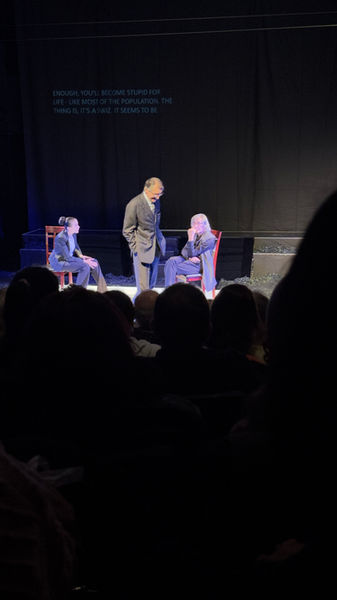
It was “Equus.”
Peter Shaffer.
One of the most complex, raw, and rarely staged texts of the twentieth century — a challenge many professional theaters are afraid to take on. And here it was, performed by actors from Coney Island Avenue.
On an old, worn-out Manhattan stage, untouched by renovation for decades — a stage that still remembers the times of Danny DeVito and Bruce Willis.
With scenery taped together five minutes before curtain: a paper rectangle, three by four meters, and two chairs.
And on this modest island of light, they achieved something that even large, well-funded theaters with sophisticated lighting systems and full creative staffs do not always manage.
What unfolded before me and the packed audience was not simply a performance — it was a phenomenon.
Not acting, but confession.
Not drama, but a descent into the most dangerous zone of the human inner world — where the boundary between normality and obsession becomes transparent.
The actors — people with ordinary lives, work shifts, children, fatigue — exploded on stage with genuine passion. They created an emotional intensity that left the audience breathless. No one moved. No one rustled programs. No one looked away. People were not only watching what was happening on stage — they were looking into themselves, searching for even a shadow of these characters within. And, frighteningly enough, hoping not to find one.
Because Equus forces us to face mirrors that are hard to look into:
Who am I — normal and empty?
Or passionate, alive — and therefore dangerous to society?
This production became proof that theater is not about walls, money, or equipment.
It is about the director’s courage.
About the actor’s ability to open a wound without hiding behind psychological techniques.
About trust within the ensemble.
About honesty with the audience.
Nabi Kayumovich accomplished the impossible:
from a great play, he created grandeur;
from a confined space, a cosmos;
from amateurs, artists.
And standing behind the camera, I realized I was not documenting a performance. I was documenting the birth of a miracle. This happens once in decades — and never according to schedule.
When the performance ended, I felt a strange mixture of emotions: awe, gratitude, and a quiet shock. The feeling of having witnessed something that cannot be explained by plane words .
And I understood a simple truth:
I arrived as a volunteer — and left as a witness to real, profound theater, born on an old Manhattan stage thanks to people who were simply unafraid of reaching the hights.
And if there is a place in this city where theater is still alive, it is there:
where nurses become tragic heroines,
housewives become voices of ancient gods,
and a director from Coney Island Avenue raises Equus as if it were his personal challenge to fate.
I am grateful that I was there.
And that my camera, that evening, looked in the same direction as my heart.
Sasha A. Gegera
December 15, 2025 — New York


